
Beyond the Boardroom: Why Experiential Venues Are Redefining Meeting ROI
WRITTEN BY KARL WOOLFENDEN
For decades, the standard corporate gathering followed a predictable script: a windowless hotel ballroom, fluorescent overhead lighting, standardized seating rows, and a static podium. While these environments provided basic utility, they failed to generate true engagement.
In today’s corporate landscape, executive leaders and event planners recognize that off-site meetings are no longer just operational updates—they are strategic investments in organizational alignment. Moving corporate events out of traditional hotel spaces and into experiential venues (such as high-tech stadium districts, immersive digital art spaces, historical landmarks, or curated resort complexes) fundamentally transforms how message retention, cultural alignment, and business relationships take shape.
The Shift: Traditional Ballrooms vs. Experiential Venues
Experiential venues leverage spatial context, immersive design, and environment psychology to create multi-sensory engagement.
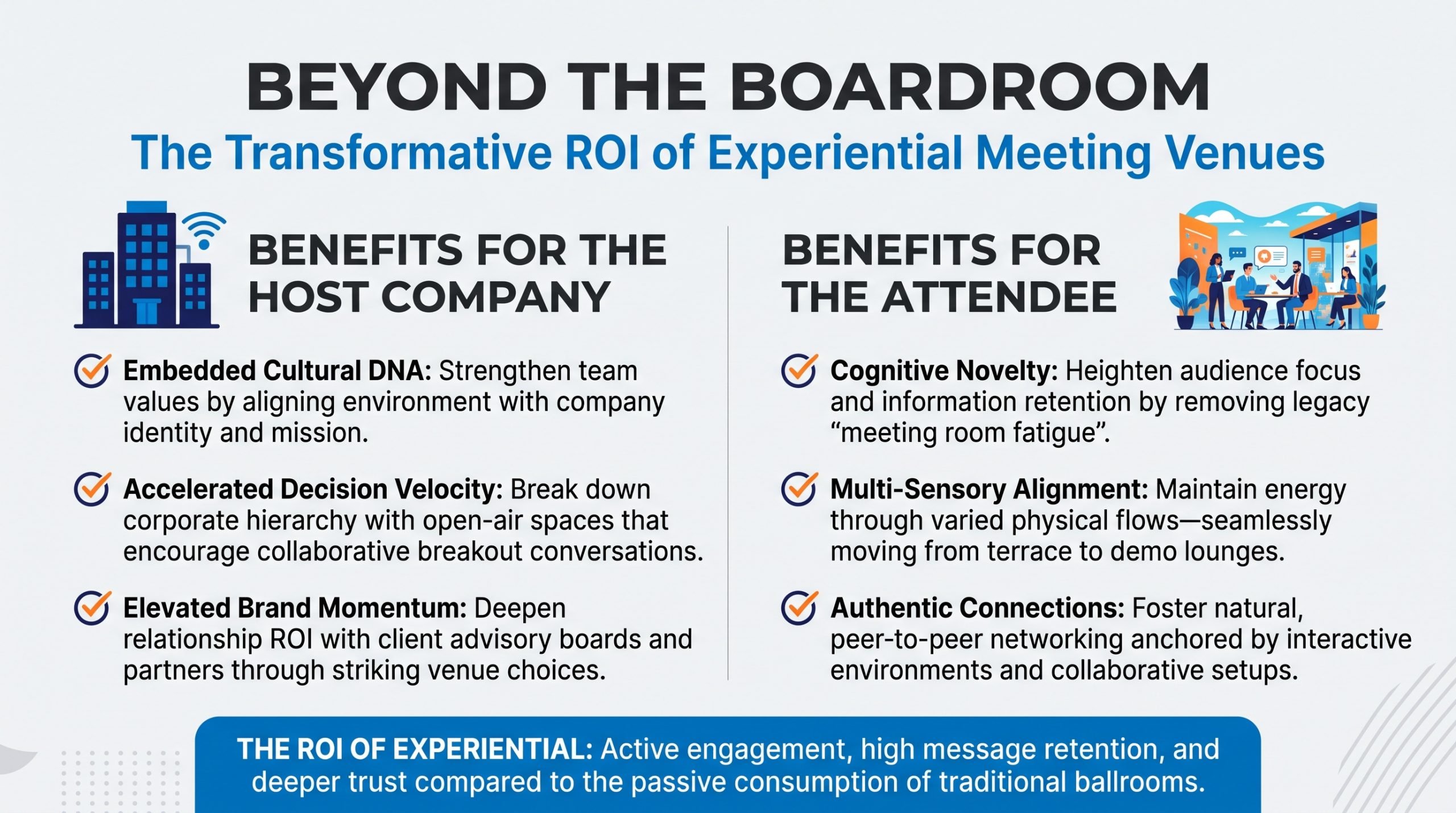
1. Benefits for the Hosting Company
For organizations dedicating capital to executive retreats, partner summits, or annual kickoffs, experiential environments deliver measurable operational returns.
Embedding Corporate Culture into Physical Space
Corporate culture cannot be reinforced through slides alone; it requires an environment that reflects company values. When a company hosts a strategy summit at a venue known for innovation, speed, or high performance (such as a modern sports complex or cutting-edge technology center), the venue itself reinforces the message. The physical setting becomes a living backdrop for the organization’s mission.
Accelerating Consensus & Decision Velocity
Traditional meeting spaces often preserve hierarchy—executives sit at the head of a long table, while broader teams remain passive. Experiential venues break down these structural barriers. Flexible layouts, open-air gathering areas, and interactive break-out spaces encourage informal exchanges between leadership and staff. This unscripted interaction speeds up alignment and reduces friction in decision-making.
Elevating Brand Positioning with External Stakeholders
When hosting client advisory boards, partner summits, or investor meetings, the venue acts as a direct reflection of brand prestige. Choosing an immersive or distinctive venue signals forward-thinking leadership, making a lasting impression that differentiates the host from competitors using standard conference centers.
2. Benefits for Attendees
From the attendee perspective, experiential venues replace event fatigue with genuine engagement. The psychological impact of novelty, sensory rich environments, and shared activities creates a far more rewarding experience.
The Neuroscience of Memory & Novelty
The brain is wired to ignore routine environments while remaining heightened to novelty. When attendees step into a venue featuring striking architecture, panoramic views, or interactive technology, their focus naturally increases. Information presented in novel environments is coded more deeply in memory, ensuring that key strategy points are retained long after the event ends.
Eliminating Meeting Fatigue
Sitting in a standard conference chair under artificial light for eight hours induces cognitive exhaustion. Experiential venues counter this fatigue by offering varied spatial flows—allowing teams to move seamlessly from formal presentations to outdoor terraces, immersive demo stations, or private dining rooms. This physical movement maintains energy levels throughout the day.
Authenticity in Networking
Professional networking can feel forced in a formal setting. Experiential venues integrate natural conversation starters—whether through interactive displays, unique culinary concepts, or shared activities. These context-rich surroundings enable genuine connections, helping attendees form authentic professional relationships built on shared experiences.
Designing the Future of Meetings
The success of a corporate meeting is measured by what happens after attendees leave. By moving away from rigid, legacy meeting rooms and embracing environments built around experience, human connection, and spatial design, companies can turn standard gatherings into catalysts for real organizational growth.


