
Social-Emotional Learning Through Team Play

How sports and enrichment programs help children build empathy, confidence, and lifelong social skills
Walk onto any playground or sports field and you’ll see more than just games in motion. You’ll see children negotiating, encouraging, celebrating, and sometimes — learning to handle disappointment. What might look like simple play is actually one of the most powerful forms of education: social-emotional learning (SEL) through movement and teamwork.
From ages four through ten, children’s brains are developing at a rapid pace, not just cognitively but emotionally. They are learning to manage feelings, understand others’ perspectives, and build healthy relationships — all essential life skills. Team sports and structured enrichment programs offer the perfect environment to practice these abilities in real time.
In today’s world of screens, reduced playground time, and social isolation, helping children strengthen their social-emotional skills through active play has never been more critical.
What Is Social-Emotional Learning (SEL)?
Social-emotional learning is the process of developing self-awareness, self-control, social awareness, relationship skills, and responsible decision-making. These competencies are foundational for success in school, friendships, and life.
The Collaborative for Academic, Social, and Emotional Learning (CASEL) identifies five key pillars of SEL:
- Self-awareness – recognizing one’s emotions, strengths, and limitations.
- Self-management – regulating emotions, behaviors, and impulses.
- Social awareness – showing empathy and understanding different perspectives.
- Relationship skills – communicating clearly, cooperating, resolving conflicts.
- Responsible decision-making – making ethical, constructive choices about behavior.
According to a landmark CASEL meta-analysis of 213 school-based programs involving over 270,000 students, participation in SEL programs improved students’ social skills, emotional well-being, and academic performance — while reducing anxiety, aggression, and behavioral issues.¹
The research is clear: children who learn emotional intelligence early tend to become more resilient, cooperative, and confident adults.
Why Team Play Builds SEL Naturally
While SEL can be taught in classrooms, it’s experienced on the field. Team play transforms abstract ideas like empathy or self-regulation into tangible lessons.
When children play together, they learn:
- Empathy: Understanding that teammates may have different abilities, moods, or frustrations.
- Communication: Expressing needs (“Pass the ball!”) and encouragement (“You got this!”).
- Cooperation: Working toward a shared goal rather than personal success.
- Self-control: Managing disappointment when losing or waiting their turn.
- Resilience: Trying again after mistakes or challenges.
A 2019 study published in Frontiers in Psychology found that children who participated in organized sports demonstrated significantly higher emotional regulation and prosocial behavior than their peers who didn’t engage in team-based physical activity.²
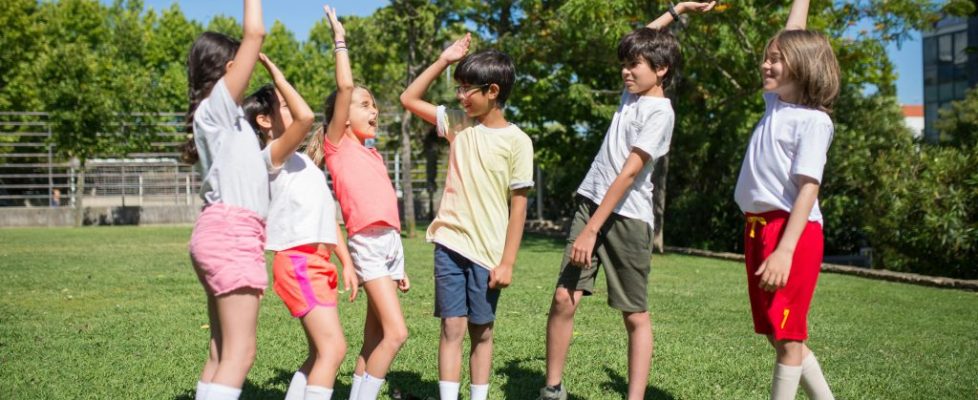
In short: every high-five, every assist, every moment of teamwork is an SEL lesson in action.
Ages 4–6: Foundations of Friendship
At ages four to six, children are just beginning to navigate group dynamics. This is when team activities become a social training ground.
Structured games help children learn turn-taking, listening, and sharing success. Cooperative games (like parachute play, relay races, or team obstacle courses) introduce the concept of collective achievement: we win when we work together.
Movement-based enrichment programs also provide guided opportunities to handle emotions. When frustration arises (“I didn’t get the ball!”), supportive coaches can model empathy and self-regulation by acknowledging feelings and guiding problem-solving:
“I see you’re disappointed. Let’s take a deep breath, and we’ll try again next round.”
According to developmental psychologist Dr. Alison Gopnik at UC Berkeley, these early lessons in empathy and patience are neurologically significant — they strengthen the prefrontal cortex, the part of the brain responsible for emotional regulation and moral reasoning.³
Ages 7–10: Teamwork and Emotional Intelligence
By the time children reach seven to ten years old, they’re ready for more structured sports and group challenges. This is when team identity and leadership skills begin to emerge.
Older elementary children start to understand fairness, roles, and responsibility. They learn to manage competition — both winning with humility and losing with grace. Coaches play a key role here, helping children translate emotional experiences into constructive growth.
A 2020 study in Pediatric Exercise Science showed that participation in youth team sports was linked to higher emotional intelligence and peer acceptance, even after controlling for age, gender, and socioeconomic status.⁴
When children work through conflicts (“That wasn’t fair!”), they’re learning conflict resolution — a skill more valuable than any trophy.
The Hidden Emotional Benefits of Physical Activity
Team play doesn’t just teach social skills — it physically shapes the emotional brain. Exercise releases endorphins and serotonin, which stabilize mood and reduce anxiety. Regular physical activity also lowers cortisol, the stress hormone.
The University of Michigan’s School of Kinesiology reported that children who engage in at least three sessions of structured physical play per week demonstrate lower levels of stress and higher overall happiness.⁵
Moreover, physical activity strengthens the default mode network of the brain — the system responsible for self-reflection and empathy. Simply put, movement helps children understand themselves and connect more deeply with others.
Why Guided Enrichment Programs Work Best
While unstructured play is important, guided enrichment programs — led by trained instructors — amplify SEL benefits by providing consistent reinforcement and positive modeling.
In programs like Kidokinetics, for instance, instructors combine physical skill-building with social coaching. When a child helps a teammate or waits patiently, that behavior is acknowledged and celebrated. When frustration occurs, coaches teach coping strategies in the moment.
This structured feedback loop helps children internalize emotional intelligence rather than just experiencing it by chance. It also provides a psychologically safe environment — every child is supported to take risks, try new things, and grow emotionally as well as physically.
Kidokinetics: Movement with Meaning
At www.kidokinetics.com, the mission goes beyond sports — it’s about helping children grow into confident, compassionate, and resilient individuals through movement.
Kidokinetics programs introduce children ages 2–10 to a wide variety of sports and physical activities, from yoga and balance exercises to cooperative games and relay challenges. Each session is intentionally designed to promote both physical coordination and social-emotional development.
Trained coaches emphasize teamwork, communication, and positive sportsmanship — celebrating effort and progress as much as performance. Whether children are high-fiving a teammate or learning to manage frustration, every activity reinforces the principles of empathy, cooperation, and confidence.
The result? Children who not only develop motor skills and fitness, but also emotional literacy — the ability to understand themselves and others. Parents often share that their kids become calmer, more cooperative, and more socially aware after just a few weeks of participation.
Practical Tips for Parents and Educators
Even outside structured programs, you can nurture SEL through physical play at home or school:
- Model emotional language: “I feel proud when we work together!”
- Encourage cooperation over competition: Plan games where the whole group succeeds together.
- Acknowledge effort: Praise persistence, not just performance.
- Discuss emotions openly: After games, ask, “How did you feel when your team worked together?”
- Provide safe challenges: Let children fail safely and learn from mistakes.
As developmental psychologist Dr. Susan David notes, “Children who learn to name, understand, and navigate their emotions early on develop the emotional agility needed for lifelong success.”⁶
Conclusion: Building More Than Players
Team play in early childhood is far more than exercise — it’s a blueprint for emotional intelligence. Through laughter, teamwork, and even occasional frustration, children learn the essential human skills of empathy, cooperation, and resilience.
When we invest in programs that blend physical movement with social learning, we’re not just building athletes; we’re shaping future leaders, friends, and problem-solvers.
Every time a child passes a ball, encourages a peer, or tries again after falling — they’re practicing the art of being human.
References
- Durlak, J.A. et al. (2011). Child Development. “The Impact of Enhancing Students’ Social and Emotional Learning.”
- Oberle, E., et al. (2019). Frontiers in Psychology. “Team Sports and Emotional Regulation in Children.”
- Gopnik, A. (2016). UC Berkeley Center for Developmental Cognitive Science.
- Babic, M.J. et al. (2020). Pediatric Exercise Science. “Sports Participation and Emotional Intelligence in Childhood.”
- University of Michigan School of Kinesiology (2018). “Physical Activity, Stress, and Happiness in Youth.”
- David, S. (2017). Emotional Agility. Avery Publishing.


